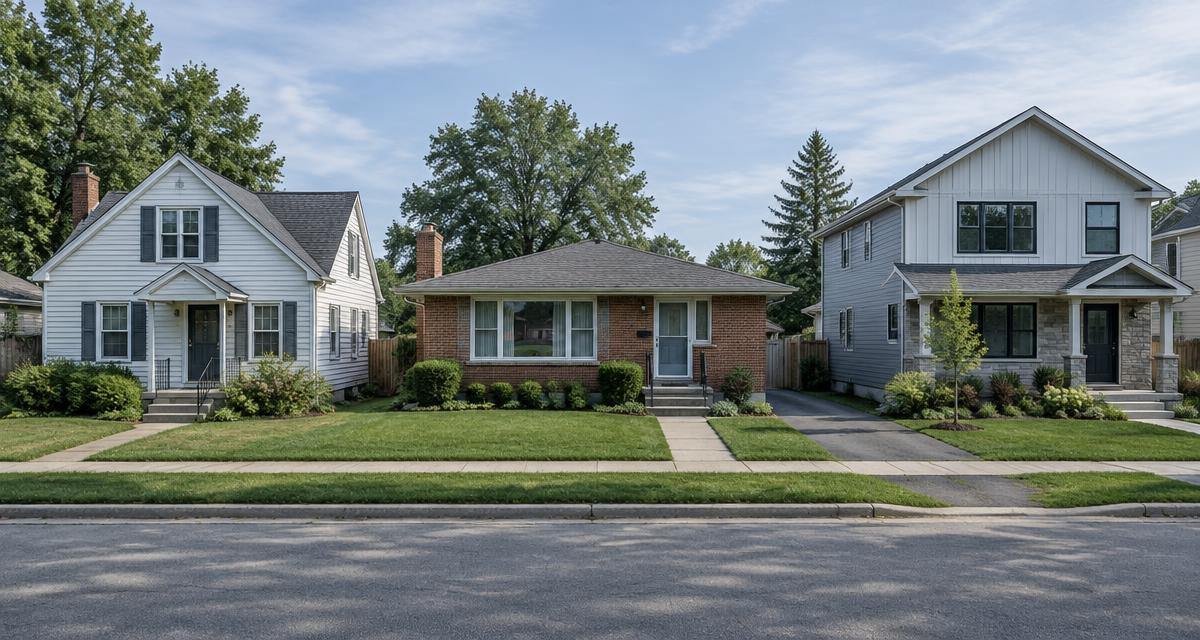
When a homeowner checks what their house is worth on a real estate portal, a real estate portal, or any real estate website, the number they see was generated by an automated valuation model, or AVM.
AVMs are everywhere. They power the estimates on major real estate portals, drive automated home valuation emails, and increasingly inform the conversations homeowners have before they ever call an agent. Understanding how they work, and where they break down, is genuinely useful for any real estate professional.
For a separate test of a general-purpose chatbot, read our ChatGPT home valuation accuracy study of 198 homes. It explains why chatbot results should not be treated as an accuracy score for dedicated AVMs.
What an AVM Actually Does
An automated valuation model is a statistical algorithm that estimates a property's current market value without a physical inspection, using data that is available through public records and market databases.
The core inputs most AVMs use:
Comparable sales data. The most fundamental input. The AVM looks at properties similar to the subject property that have sold recently in the same area and uses those sales to anchor the estimate.
Property characteristics. Size, age, number of bedrooms and bathrooms, lot size, and property type are the basic hedonic attributes that distinguish one property from another within a market.
Market index data. Rather than always requiring a nearby comparable sale to anchor an estimate, many AVMs use a market index, a measure of how prices in a given area have changed over time, to adjust an older sale forward or backward to reflect current conditions.
Location data. Neighborhood, ZIP code, school district, and proximity to amenities all factor into location adjustments.
The algorithm combines these inputs through statistical modeling, typically regression analysis, machine learning, or a combination, to produce a point estimate and, in some implementations, a confidence range.
The Two Main Approaches
AVMs generally fall into two broad categories, though most production systems blend elements of both.
Comparable sales (hedonic) models work by finding recently sold properties similar to the subject and adjusting for differences. A property with three bedrooms in a ZIP code where the average recent sale was $400,000 with three bedrooms gets a baseline estimate near that price, adjusted up or down for specific differences in size, age, and condition.
These models are most accurate when there are many recent comparable sales nearby. In high-transaction markets with consistent housing stock, they perform well. In rural areas, unique properties, or markets with thin transaction volume, the lack of good comparables causes accuracy to degrade quickly.
Index-based models work differently. Rather than finding comparables each time, they track how an index of prices in a given area has moved over time. If a home was purchased for $350,000 in 2018 and the market index for that ZIP code has risen 40 percent since then, the model estimates the current value at approximately $490,000.
Index-based approaches are useful for properties where recent comparable sales are scarce and for generating estimates at scale across millions of properties. The limitation is that the index tracks the average property; it cannot account for what has happened to this specific property since purchase.
Why AVM Accuracy Varies
AVM accuracy is not uniform. It varies significantly based on several factors:
Data availability. AVMs are only as good as the data they can access. In non-disclosure states, where sale prices are not publicly recorded, AVMs have less transaction data to work with and tend to produce wider error ranges. Texas, for example, is a non-disclosure state, which is why a real estate portal online estimates in Texas are often less accurate than in disclosure states like Florida or California.
Property type. Single-family homes in established suburbs with consistent housing stock produce the most accurate AVM estimates. Condos, multi-family properties, rural homes, and unique architectural properties are all harder for AVMs to value accurately because the comparison set is smaller and less consistent.
Market conditions. In rapidly changing markets, such as a fast-rising market or a sudden correction, AVMs that rely on recent comparable sales can lag actual market conditions by weeks or months. The data they use reflects what sold recently, not what is happening today.
Hold period. For properties that have been owned for many years, the gap between what an index predicts and what the specific property is actually worth tends to widen. Renovations, deferred maintenance, additions, and neighborhood changes accumulate over time in ways that no index can track at the individual property level.
What AVMs Cannot See
The fundamental limitation of any AVM, regardless of how sophisticated the algorithm, is that it cannot observe the specific property.
An AVM does not know:
- Whether the kitchen was renovated last year or has not been updated since 1985
- Whether the roof was replaced recently or is approaching end of life
- Whether the lot backs to a highway or to a park
- Whether the home was maintained meticulously or let go
- Whether the listing photos show a staged showroom or a lived-in reality
These property-specific factors can contribute to a material difference between what an AVM estimates and what a property actually sells for. This is not a failure of the algorithm; it is the fundamental constraint of valuing real property without inspection.
This is why AVMs are best understood as market-data estimates rather than appraisals. They tell you what properties like this one in this area are worth right now. They cannot tell you where this specific property sits within that range.
How Real Estate Agents Use AVMs Effectively
The most effective way to use an AVM is as a starting point for a conversation, not as a final answer.
For nurturing past clients and seller prospects, automated home valuation emails built on AVM data serve a specific purpose: they give the homeowner a regular, data-backed reminder that their agent is paying attention to their home's value. The homeowner gets a useful reference point. The agent stays attached to their next move. The conversation that follows, when the homeowner calls to ask whether the estimate is accurate, is where the agent's expertise actually matters.
For listing presentations, an AVM estimate can anchor the conversation about pricing. Showing a seller what automated tools say their home is worth, and then explaining why a properly prepared CMA may tell a different story, positions the agent as the expert who understands both the data and its limitations.
For buyers evaluating homes, AVM estimates provide a quick sanity check against asking prices. A home listed significantly above or below its AVM estimate warrants additional investigation; either it has features the algorithm cannot see, or there is something wrong.
The Bottom Line
AVMs are powerful tools that have made real estate data more accessible to consumers and more scalable for professionals. They are not replacements for professional judgment, physical inspection, or a properly prepared comparative market analysis.
Understanding how they work, what data they use, where they are accurate, and where they break down, makes any real estate professional more effective in conversations with clients who have already checked their home value online before picking up the phone.
Touchpoint Valuation sends automated monthly home valuation emails to real estate agents' past clients and seller prospects, built on ZIP-level market data and historical housing data, market-data estimates. Current plans and prices are always listed on our pricing page.